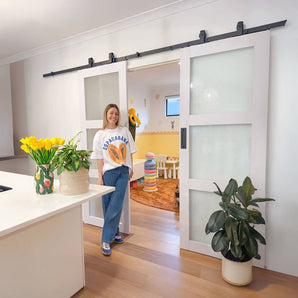
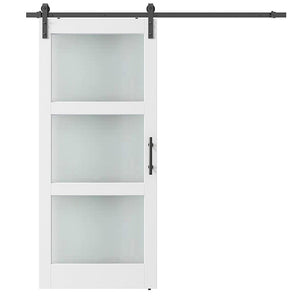
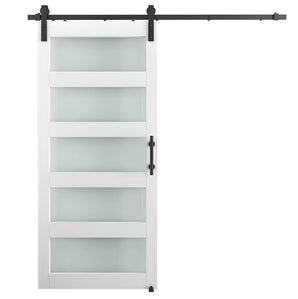
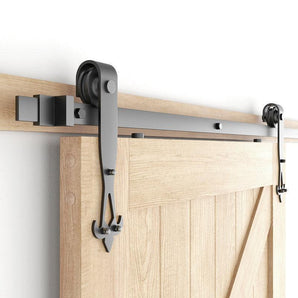
The short answer is yes — absolutely.
In Australia, plasterboard and drywall walls are extremely common in modern homes, and barn doors can be installed successfully on these types of walls without any issues when installed correctly.
The key factor is not the plasterboard itself, but how the barn door track is supported behind the wall.
Why Proper Support Matters
A barn door system works by suspending the door from a sliding track mounted above the doorway. Because the entire door weight is carried by the track, the mounting points must be strong enough to support both the static weight and the movement of the door over time.
For this reason, the mounting screws should ideally be fixed directly into the wall studs (timber framing) behind the plasterboard.
This creates a much stronger and more secure installation compared to fixing only into the plasterboard itself.
The Common Problem: Stud Positions Don't Always Match the Track Holes
One of the most common installation challenges is that the pre-drilled holes on the barn door track are fixed in position, while the wall studs inside the wall may not line up perfectly with those holes.
This is very common in Australian homes.
There are generally two ways to solve this problem.
Option 1: Plan Ahead During Construction
If the wall has not yet been built, and you already know you want to install a barn door later, you can pre-plan the stud positions during framing.
Some homeowners or builders purchase the barn door hardware first and use the track hole spacing as a guide when building the wall frame. This allows the studs to be positioned exactly where the mounting holes will be.
This creates the cleanest and strongest installation method.
Option 2: Use a Supporting Board
If the wall is already finished, the most common solution is to install a supporting board (also called a backing board or mounting board).
The supporting board is securely fixed across multiple wall studs first, and then the barn door track is mounted onto the supporting board.
This method effectively distributes the door weight across several studs and removes the limitation of the track holes needing to align perfectly with individual stud positions.
It is one of the most common installation methods used for barn doors on plasterboard walls.

Using a Stud Finder Is Highly Recommended
To install a supporting board or track correctly, you first need to locate the wall studs accurately.
A quality stud finder is strongly recommended for this process.
While experienced installers can sometimes identify stud locations by tapping the wall manually, using a stud finder is much safer and more reliable.
For Australian homes, it is best to use a higher-quality stud finder that can detect:
- Timber studs
- Electrical wiring
- Plumbing pipes
Some cheaper stud finders can be inaccurate, which increases the risk of drilling into hidden electrical cables or water pipes inside the wall.
Although this type of accident is relatively uncommon, using a better stud finder is a worthwhile safety precaution before drilling into any plasterboard wall.
Horizontal or Vertical Timber Support — Both Can Work
Many customers ask whether the track must be fixed into vertical studs only.
In practice, both horizontal and vertical timber framing can work, provided the structure is strong enough to support the door weight securely.
The most important factor is achieving solid load distribution and proper fastening strength.
When attaching a supporting board to the wall framing, it is generally recommended to use at least two screws per stud connection point for improved strength and long-term stability.

What About Brick Walls?
Brick walls are actually even easier for barn door installations.
Most barn door hardware kits designed for the Australian market include suitable masonry anchors or fixing accessories for brick or concrete walls.
As long as the correct masonry fixings are used, barn doors can be mounted very securely onto brick walls without any problems.
Will Wall Insulation Cause Problems?
Many plasterboard walls in Australian homes contain insulation batts inside the wall cavity.
During installation, longer mounting screws may sometimes come into contact with the insulation material behind the plasterboard.
This is completely normal and generally does not affect the installation or performance of the barn door system.
However, if the insulation is particularly dense and excessively long screws are used, it is worth checking that the screws are still achieving proper anchoring strength into the timber framing.
Choosing the Right Supporting Board
The size and thickness of the supporting board depends largely on the material being used.
Recommended Thickness
- Hardwood supporting boards can generally be slightly thinner
- Softer timber such as pine is usually recommended at around 20mm thickness
For most residential barn door installations in Australia, a 20mm supporting board is typically sufficient.
Recommended Width
The supporting board should generally be wider than 60mm.
This is because many barn door tracks are approximately 60mm high, and the board should fully support the track width.
Wider boards are perfectly acceptable and often chosen based on appearance preferences.
Important: Consider Skirting Boards and Power Points
One important detail many homeowners overlook is wall clearance.
Installing a supporting board pushes the track slightly further away from the wall, which also increases the distance between the door and the wall surface.
This is often necessary in Australian homes because of:
- Skirting boards
- Architraves
- Protruding power points
- Wall switches
The supporting board thickness can be adjusted to create enough clearance so the barn door slides smoothly without hitting these obstacles.
For most installations, a 20mm supporting board provides sufficient spacing, but every home is slightly different and should be checked individually before installation.
Frequently Asked Questions
Can barn doors be installed on plasterboard walls in Australia?
Yes. As long as the track is secured into wall studs or a properly fixed supporting board, barn doors can be safely installed on plasterboard walls.
Do I need a stud finder to install a barn door?
It is strongly recommended. A quality stud finder helps you locate timber framing accurately and avoid hidden electrical wiring or plumbing pipes.
What thickness supporting board should I use for barn door installation?
For most Australian residential installations, a 20mm thick supporting board is sufficient. Hardwood boards can be slightly thinner, while pine boards should be at least 20mm.
Can barn doors be installed on brick walls in Australia?
Yes, brick walls are actually easier to work with. Most barn door hardware kits include masonry anchors suitable for brick and concrete walls.
Will wall insulation affect my barn door installation?
No. Insulation batts inside the wall cavity are normal and generally do not affect installation. Just ensure screws are still achieving proper anchoring into the timber framing.
Final Thoughts
Barn doors can absolutely be installed on plasterboard or drywall walls in Australian homes.
The key is ensuring the track is mounted securely into structural framing or properly supported using a supporting board.
With correct planning, proper stud fixing, and suitable hardware, plasterboard walls are not a problem at all for barn door installations.

Ready to install your barn door?
Browse our complete range of barn door hardware kits — designed and stocked in Australia for Australian homes.